Physical Body Study
An R&D sandbox in Godot asking what it feels like to be a fully physical body in first person: muscle-driven ragdolls, a skin built for close-up, and eyes that actually look at you. Not a working game, but a lot learned about how a simulated body should feel to control.
This started from Half-Life, where you poke at a world that runs on physics while you’re mostly a floating camera in it. I wanted to try the opposite: what if the first-person character didn’t just carry a camera around, but actually was a physical body, built from the same ragdoll and muscles as every other character in the world?
You’d steer intent (where to go, where to look, crouch, jump) and the body would have to carry it out. Get shoved and you stagger. Fall badly and you feel it from inside your own head.
Mirror’s Edge was the other inspiration. It’s one of the few first-person games where you really feel you have a body: you see your arms and legs, and every vault and landing has weight. But its body is animated, and I wanted a more natural version of that feeling, where the movement comes out of the physics instead of being played back.
I’ll be upfront: as a game, this didn’t work out. What came out of it is a body sandbox with three parts I’m genuinely pleased with, and a much clearer sense of why physically simulated characters are so hard to make feel good.
Physics-based movement
I wanted physics that felt as solid as Half-Life’s, so I picked Godot with the Jolt physics engine and started with a sandbox of tests (walking, falling, low gravity) rather than a game. Each body is a ragdoll of 16 parts, and every joint gets three things: soft limits so limbs slow down before they bend too far, a gentle pull towards a relaxed pose, and muscles that actively drive it.
That layered idea came from Lincoln Margison’s video on improving ragdolls, and it’s what stops a falling body flopping like a sack. My first version was “jelly like, wibbly wobbling”, so I moved the muscles onto the physics engine’s own joint springs, which can be calmed down far more.
Then realistic joint ranges made them rigid. So I went for something very subtle: slightly tighter limbs and a firmer neck. The neck kept looking odd every time I tested, so it got the most attention.
The controller that survived is an assisted “puppet”: a hidden balance force holds the body up and steers it. It only helps while the feet are on the ground, though. That was my compromise: fake the boring part, standing upright, so that the moments players watch (jumping, falling off a ledge, being blasted) can be real physics.
Most of the work turned out to be interaction design dressed up as physics tuning:
The cameraI wanted you to feel the body's bob and sway without the view ever feeling mushy, so aiming stays crisp while you're conscious and only hands over to the real head as you go limp.
Personal spaceNothing ever clips into your face: other bodies get gently pushed back, and the camera pulls in if something gets too close.
Your own handsOne key switches the mouse from looking to moving your right hand, and whatever you pick up pulls back on your body.
HitsA shove is a stagger you recover from, not a canned animation.
The hand switch is the part I see as the heart of the game. Press Q and the mouse stops moving your view and starts moving your right hand instead, reaching through the arm’s real joints. Press it again and you’re looking around.
I want interacting with the world to work like a VR game rather than a “press E to use” prompt. To push a button, open a door or pick something up, you physically move your hand to it, and the body has to reach. Whatever you hold has real weight and pulls back on you, so a heavy box feels heavy.
One finding stuck with me. At full muscle strength, a conscious fall looked “sooo rigid like plastic mannequins”. Dropping the muscles to about a third of their strength is what made it read as a person: it reaches out, lands on its hands and knees, and its arms give way.
The other lesson was about how I work. On day one I tuned the muscles into something worse (“I think I ruined this, we had a good core at the start”) and had no history to go back to.
The ragdolls had been fine and only needed improving, but each fix made them a little stiffer. I rebuilt from an earlier snapshot, and from then on every change got its own commit, so ideas were cheap to try and cheap to throw away.
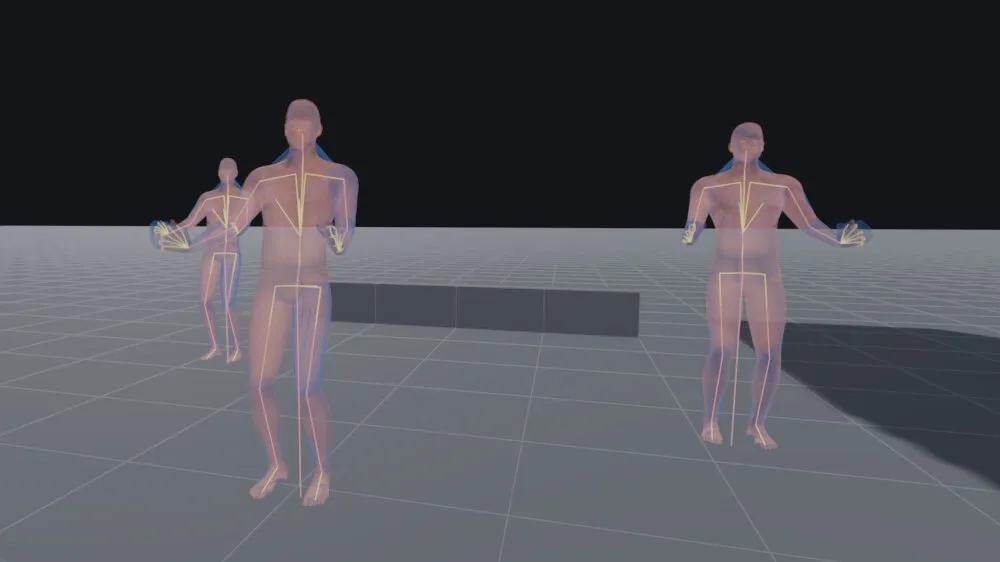
The part that failed was the ambitious one. The assisted bodies still looked “puppeted by strings attached from above”, and that was what I noticed most in every test. So I went after a body that balances and walks on its own muscles with no hidden help at all, like the Euphoria system behind GTA IV’s characters.
This time I went carefully, one stage at a time, with automated tests for each so I’d know straight away if something slipped back. It got surprisingly far: it can stand on its own indefinitely, take a firm shove or a short drop, and march on the spot.
A ragdoll that’s about to fall looks fine until it isn’t, so I built an overlay to see what was going on:
YellowThe body's centre of weight.
GreenThe area under the feet. Keep the yellow over it and you stay up.
MagentaWhere the body would need to step to stop itself falling.
Joint dotsHow hard each muscle is working, from green (easy) to red (flat out).
The readout along the top confirms the hidden help is switched off.
But it never really walked. The planted foot slid, the foot that needed to lift stayed stuck, and the body swayed sideways without catching itself. Many hours of tuning didn’t fix it.
The most useful thing I learned was why. Whenever the body’s goals were worked out from where it already was, they just followed it around, so the muscles never had anything to push against.
The overlay shows exactly where it breaks. Pushed from the front, the magenta marker shoots out behind its heels, and the body steps backwards again and again trying to get a foot under it, but never catches up.
So I called it myself: “this will keep going too much… the results are just not good enough.”
Coming back later, I could see it was a tangent that had pulled the whole project off course. No player would notice a body walking on real muscles, but they would notice the fake parts looking fake. So I removed it, kept a backup and a write-up of what I’d found, and went back to making the assisted puppet convincing.
Skin
A first-person body puts the skin right in front of you, so it had to hold up close. I also wanted to swap characters easily, so the sandbox reads any humanoid model’s skeleton and builds the ragdoll to fit it. That paid off later, when I dropped in a second test body without hand-tuning anything.
My first look inside the skin showed the usual capsules and boxes (“big Lego blocks”), which didn’t match the body you could actually see. So the skin is now cut into one piece per body part, and each piece is shrink-wrapped into a simple shape just inside it. What you see is what collides.
I kept every body one light beige tone on purpose. I tried a range of skin tones, but I didn’t want them looking too realistic yet, and a plain tone shows shape and shading clearly.
Light through skinThin parts like ears, nostrils, lips and fingers glow softly when lit, and thick parts like the torso don't.
Pore detailFine skin detail that moves with the body instead of swimming over it, with no visible seams.
Cleaner bendsHips and armpits crease naturally instead of pinching when limbs bend.
HandsFingers curl together the way real ones do, and I matched the relaxed pose to a reference kit of hand poses.
Eyes
I wanted the bodies to feel aware of you, so they watch whoever is looking at them. I went with the same order people use without thinking: eyes first, then head, then body.
Small glances are just the eyes. Look further away and the head turns too, and once you’re well off to the side, the whole body turns to face you. Each eye aims on its own, so they cross slightly on close things, and when a body is knocked out the eyes go slack.
My first eyes read as shiny 3D balls, so I took the shadow off the eyeball and made the pupils black. I tried adding fleshy corners, but they never showed properly, so I dropped them and coloured the inside of the head pink instead. Simpler, and better.
Placing the eyeballs in the sockets was the same problem I’d hit placing a hand-held magnet in an earlier project, so I reused that fix: live sliders in the running game, and a button that copies the values once they look right.
Where it’s at
It’s a sandbox, not a game. The assisted puppet stands, walks, falls, gets knocked out and gets up, but its feet lag on tight turns and getting up is still a lift rather than a real roll and push.
The biggest remaining tell is weight. The hidden help lifts the body directly, so the feet carry nothing: bodies glide on “hover shoes”, and a thrown box spins one round “like a boomerang”. My last experiment pushes that help through the planted feet instead, which cut the sliding and spinning a lot, but made the walk slower and jerkier, so I haven’t kept it yet.
Development is on hold for now, and the honest reason is that I hit the limit of what I know. The answer isn’t more pure physics. A body that walks entirely on its own muscles would take years to get right, which is far too much for what this concept needs.
The better route is the Euphoria approach: animation provides the intent and the style of a movement, and the physics reacts on top, so a hit or a stumble still plays out for real. To build that I need to get properly comfortable working with animation, so I’m going away to learn it, and I’ll come back to this project to build that hybrid version.
I also want to learn better ways to train the body. Euphoria’s behaviours came from trying things many times, keeping the best results and building on them, rather than hand-tuning every number like I did. I’d already sketched a plan for tuning the gait automatically this way, and it’s the other piece I want to understand before picking this back up.
What I’m taking away is mostly about feel: a physically simulated body has to fake a few things (a crisp camera, a little help with balance) so that the parts that matter, hits and falls, can be real.
Character model: “Women/Female Body Base Rigged” by camilooh, CC-BY 4.0. Eyes: “Procedural Eyes For Ray II” by ChamberSu1996, CC-BY 4.0.